· SPACE · 9:28
Why Catching Rockets Changes Everything
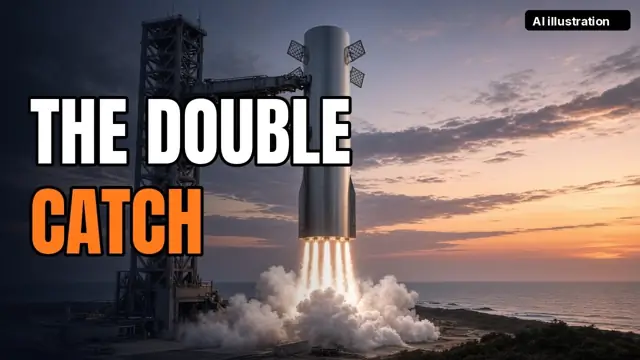 Watch ▶
Next month SpaceX wants to catch BOTH halves of Starship with the launch tower for the first time. Here's how a rocket catch works, the tech behind it (Mechazilla's chopsticks, the tile heat shield, Raptor), the reuse economics, the bear case, and why it matters for the decade.
Not investment advice. Educational content and opinion only. The author may hold shares in companies discussed. Disclosure
Companies: SpaceX
Transcript
From the video captions, split by chapter. Timestamps link to that moment on YouTube. Corrections are marked inline.
0:00 Hook
Next month, SpaceX wants to do something no one has ever done: catch an entire orbital rocket, and keep both pieces. On Starship Flight 15, the tower will try to catch the Super Heavy booster, and then the Ship itself. On the October twentieth earnings call, Elon Musk put it like this: "If we succeed, it will be the first time that an orbital launch vehicle has been fully recovered." Here's the bet. A rocket you catch and fly again stops being something you throw away, and starts working more like an airplane.
This is Bet The Decade. In the next ten minutes: how the catch actually works, the technology behind it, the economics, and what could still go wrong.
0:44 How a catch works
Start with the flight. Super Heavy lifts the whole stack, then separates from the Ship a few minutes after liftoff. Instead of falling into the ocean, the booster flips, fires its engines to turn around, and flies back toward the launch site. Near the tower, it slows to a hover, and two giant steel arms swing shut around it.
The arms are nicknamed the chopsticks, and the tower is called Mechazilla. The booster has no landing legs. The tower is the landing gear. Why do it this way?
Legs are weight, and weight is payload you don't carry. And a booster caught right at the pad can be inspected, refueled and stacked again, with no trip back from the sea. It has worked before. On Flight 5, in October 2024, the tower caught a booster on the very first try.
Flights 7 and 8 repeated it in January and March 2025. On Flight 6, the catch was called off, and the booster went into the Gulf instead. Two of those caught boosters later flew again, on Flights 9 and 11. Then the program switched to the bigger version three rocket, and the next three boosters all ended in the Gulf while engineers worked on engine relights.
So the booster catch is proven. The Ship catch has never even been tried.
2:06 Why the Ship is the hard part
Here's why. The booster turns around high over the Gulf and comes back at a fraction of orbital speed. The Ship comes home from orbit, at roughly twenty-eight thousand kilometers per hour. To survive that, it falls belly-first through the atmosphere, and its belly is covered in a heat shield.
That heat shield is more than eighteen thousand hexagonal ceramic tiles, attached to a stainless-steel airframe. A tile that cracks or falls off, or a gap that lets hot plasma slip behind it, can damage the steel underneath. In July, on Flight 13, the Ship deployed its satellites and splashed down intact in the ocean, which gave engineers their best look yet at how the tiles held up. For a catch, the Ship flips upright near the ground, lights its engines, and drops into the arms, much like the booster does.
But it also has to fly back over land, including northern Mexico, instead of over empty ocean. That's why the license matters. On the same call, SpaceX President Gwynne Shotwell said: "We have had significant constructive engagement with the FAA, and we expect the license for our Flight 15 to include return to launch site and tower catch for both stages." For this attempt, the hardware is Booster 22 and Ship 42. Days ago, the booster fired all thirty-three of its engines, and the Ship fired all six.
3:35 Raptor: the engine that makes it possible
Those thirty-nine engines are the second technology: Raptor. Thirty-three on the booster, in rings of three, ten and twenty. Six on the Ship: three for the atmosphere, three for vacuum. Raptor burns liquid methane and liquid oxygen in a cycle called full-flow staged combustion.
Two preburners, one rich in fuel and one rich in oxygen, each drive their own turbopump, and all of the propellant ends up in the main chamber. Nothing is dumped overboard. That design lets the turbines run cooler, which is good for engine life. And methane burns cleaner than kerosene, so there is less soot to clean between flights.
When SpaceX unveiled Raptor 3 in 2024, it listed two hundred eighty tonnes of thrust per engine, at just over fifteen hundred kilograms of engine mass. For a catch, the key job is relighting. Engines have to restart reliably on the way home, every time. That is exactly where version three has struggled this year.
4:39 The economics of catching
Now the money. A NASA analysis put the Space Shuttle at about fifty-four thousand five hundred dollars per kilogram to low Earth orbit. The historical average was about eighteen thousand five hundred. Falcon 9, by reusing only its first stage, brought that down to roughly two thousand seven hundred dollars per kilogram.
And reuse is no longer a theory. In August, one Falcon 9 booster flew for the thirty-seventh time. Last year, Falcon 9 flew one hundred sixty-five missions, all of them successful. Starship goes further, because both stages come back.
In its prospectus, SpaceX says Starship is designed to cut the cost to orbit by ninety-nine percent or more versus that historical average. That's a company goal, not a result yet. But low cost only works with high cadence. A rocket that flies once a quarter is still expensive, no matter how reusable it is.
Musk on the call: "The rate at which we launch Starship will increase dramatically as we solve the rapid and complete reusability." His target is weekly Starship flights in the first half of 2027, and twice weekly in the second half. Musk's timelines often slip, so treat that as ambition. The regulators are moving too. Starbase is currently allowed twenty-five launches a year.
Earlier this month, the FAA opened a review of a plan for up to four hundred fifty-six. Nothing is approved yet.
6:12 What full reuse unlocks
The first customer is SpaceX itself. On Flight 14 in September, Starship reached orbit for the first time, and deployed twenty-six Starlink V3 satellites. It was also the first Starship flight to earn revenue. SpaceX says that one launch added about ten times the downlink capacity of a Falcon 9 Starlink launch.
Multiply that by weekly flights, and the network can grow at a pace that, in my view, is very hard to copy. Second, the Moon. To leave Earth orbit fully loaded, Starship has to be refueled in orbit by tanker ships. SpaceX plans its first ship-to-ship refueling test early next year.
NASA describes the plan in steps: tankers fill a depot in orbit, and the depot fuels the lunar lander. Artemis III, planned for 2027, is now a docking test in Earth orbit. NASA is targeting the first landings, starting with Artemis IV, in 2028. If tankers come home and fly again, a Moon landing becomes a logistics problem, not a heroic one-off.
And Mars? SpaceX skipped the 2026 window to focus on the Moon. Its own site now says cargo missions start no earlier than 2028. Mars is the long-dated option, not the base case.
7:37 The bear case
Now, the other side of the trade. First, regulation. As of today, the FAA's Starship page lists no Flight 15 license, and SpaceX has not published a launch date. November is a target.
Second, failures. Ships were lost on Flights 7 and 8. On Flight 12, five of the booster's engines failed to relight, it hit the Gulf hard, and the FAA required a mishap investigation. Third, the heat shield.
Catching a Ship is one thing. Flying it again without weeks of tile repair is the real test, and no one has done that yet. Fourth, even Musk hedged: "Success is not guaranteed on these first flights, but I'd say it's more likely than not that this succeeds next flight." And timelines move. Artemis III went from a landing to an orbit test, and Mars slipped past 2026.
In this business, schedules move to the right.
8:37 The thesis
So here's my view, and it is opinion. The booster catch proved the tower works. The Ship catch is what turns Starship from a test program into a machine. If both stages come home, cost per kilogram falls, cadence rises, Starlink grows faster, and the Moon gets cheaper.
Each step feeds the next. Watch three things: the Flight 15 license from the FAA, whether the Ship survives its catch with the tiles intact, and how quickly SpaceX re-flies a Ship. The company is aiming for early next year. If you want the sixty-second version, the Short on the double catch is linked below, along with our full SpaceX breakdown.
This is not financial advice. Is this worth a decade? You decide.
Sources (36)
| Fact (as used) | Source 1 | Source 2 (+3) |
|---|---|---|
| Flight 5, Oct 13 2024: tower caught the booster on the first try | https://www.space.com/spacex-starship-flight-5-launch-super-heavy-booster-catch-success-video | https://spacenexus.us/starship/catches ; whel.de catch log |
| Flights 7 (Jan 16 2025) and 8 (Mar 6 2025) caught boosters | https://www.space.com/space-exploration/private-spaceflight/spacex-loses-starship-upper-stage-again-but-catches-giant-super-heavy-booster-during-flight-8-launch-video | https://spacexi.com/starship-booster-recovery ; https://myrgv.com |
| Flight 6 (Nov 19 2024) catch called off, booster to the Gulf | spacexi.com/starship-booster-recovery | spacenexus.us/starship/catches |
| Caught boosters re-flew: B14 (F7→F9), B15 (F8→F11) | https://nextspaceflight.com/launches/details/7818/ ; https://nextspaceflight.com/starship/hardware/48/ | https://spaceexplored.com/2025/10/09/spacex-to-reuse-its-first-starship-booster-on-flight-11/ ; SpaceX F9 recap |
| No catch since F8; F12–F14 (V3) boosters ended in the Gulf; Ship never caught | https://www.teslarati.com/spacex-starship-tower-catch-flight-15/ | spacex.com flight 12/13/14 pages; https://www.nasaspaceflight.com/2026/05/starship-flight-12-v3-follow/ |
| Flight 12 (May 22 2026): 5 of 33 engines failed to relight, booster lost; FAA mishap investigation, closed Jul 13 2026 | https://www.faa.gov/newsroom/statements/general-statements | https://www.reuters.com/business/media-telecom/faa-closes-starship-review-ahead-spacexs-next-test-flight-this-week-2026-07-13/ ; https://www.cnbc.com/2026/07/13/us-agency-closes-starship-review-ahead-of-spacexs-next-test-flight.html |
| Flight 13 (Jul 24 2026): Ship deployed 20 Starlink V3, splashed down intact | https://myrgv.com/alerts-brh/2026/07/24/flight-13-launches-all-mission-goals-met-starship-makes-soft-splashdown/ | https://arstechnica.com/space/2026/07/spacex-eyes-tower-catch-for-next-starship-after-auspicious-end-to-13th-flight/ ; spacex.com flight-13 |
| Flight 14 (Sep 28 2026): first orbit, 26 Starlink V3, ~10× downlink of an F9 Starlink launch, first revenue Starship flight | SpaceX Q3 2026 results PDF https://s21.q4cdn.com/184289198/files/content_files/SpaceX-Reports-Third-Quarter-2026-Results.pdf | https://www.teslarati.com/spacex-starship-tower-catch-flight-15/ ; Q3 transcript |
| Ships lost on Flights 7 and 8 | Space.com F8 article (A2) | whel.de / Wikipedia Starship flight tests |
| Flight 15 = Booster 22 + Ship 42, Pad 2, double catch planned, November target, no official date | https://www.space.com/space-exploration/launches-spacecraft/spacex-ignites-giant-super-heavy-booster-engines-ahead-of-daring-starship-launch-video | https://www.theverge.com/science/1014913/spacex-will-try-catching-starship-and-its-booster-for-first-time-musk-says ; SpaceNews; Ars (B1) |
| B22 full-duration 33-engine static fire Oct 25; S42 six-engine static fire | Space.com (A10, quotes SpaceX post) | TeslaNorth (shorts src/tsn.html); Tesla Oracle |
| Ship return path crosses land incl. northern Mexico → license matters | https://arstechnica.com/space/2026/10/spacex-will-attempt-to-reach-weekly-starship-launches-by-early-2027/ | Teslarati (A5) |
| Fact | Source 1 | Source 2 |
| Booster has no landing legs; tower arms ("chopsticks", tower "Mechazilla") catch it | Space.com F5 (A1) | https://en.wikipedia.org/wiki/SpaceX_Starship ; Space.com PEIS article (chopstick arms) |
| Ship re-enters at orbital speed ~28,000 km/h; booster returns at a fraction of that | https://theconversation.com/starships-first-orbital-flight-put-its-heat-shield-to-the-test-how-it-fares-could-determine-if-spacexs-vision-is-possible-292960 | Ars Technica Jul 2026 (A7) |
| Heat shield >18,000 hexagonal ceramic tiles; gaps let plasma damage structure; must survive repeated flights without replacement | The Conversation (B2) | Ars Technica Jul 2026 (A7) |
| Super Heavy 33 Raptors (3/10/20 rings), Ship 6 (3 SL + 3 vacuum) | https://spaceexplored.com (Raptor 3 unveiling, 2024-08-07) | https://myrgv.com ; Wikipedia SpaceX Starship |
| Raptor: methane/LOX, full-flow staged combustion, fuel-rich + oxygen-rich preburners each driving a turbopump, all propellant to chamber; cooler turbines; methane cleaner (less coking) | https://en.wikipedia.org/wiki/SpaceX_Raptor | Space Explored 2024-08-07 |
| Raptor 3 as unveiled 2024: 280 tf thrust, 1,525 kg | SpaceX post on X via Space Explored | https://www.nasaspaceflight.com (Raptor 3 2024) ; NextBigFuture ; Wikipedia |
| V3 boosters struggled with relights in 2026 | FAA/Reuters (A6) | Ars Oct 21 "some issues with the Raptor"; NSF Oct 18 https://www.nasaspaceflight.com/2026/10/spacex-flight-15-16-milestones/ |
| Fact | Source 1 | Source 2 |
| $/kg to LEO: Shuttle ~$54,500; historical avg ~$18,500; Falcon 9 ~$2,720 | NASA NTRS 20200001093 "The Recent Large Reduction in Space Launch Cost" | https://aerospace.csis.org/data/space-launch-to-low-earth-orbit-how-much-does-it-cost/ |
| Falcon 9 booster B1067 37th flight Aug 25 2026 (record) | https://www.space.com/space-exploration/launches-spacecraft/spacex-starship-record-37th-booster-flight-100-falcon-9-launches | Wikipedia list of Falcon 9 first-stage boosters ; spacexstats |
| Falcon 9 flew 165 missions in 2025, all successful | Space.com (C3) | orbitcodex / Wikipedia 2025 in spaceflight |
| Targets: weekly Starship flights H1 2027, twice weekly H2 2027 | Q3 transcript (src/q3call.txt) | Ars Technica Oct 21 (A12) |
| Starbase currently allowed 25 launches/yr; FAA NOI Oct 14 2026 for PEIS up to 100 (phase 1) / 456 (phase 2); comments to Nov 30; not approved | https://www.federalregister.gov/documents/2026/10/14/2026-20963/ ; https://www.faa.gov/space/stakeholder_engagement/spacex_starship | https://www.space.com/space-exploration/launches-spacecraft/spacex-wants-to-launch-starship-more-than-450-times-per-year-from-south-texas ; Bloomberg Law |
| Ship-to-ship refueling test early 2027; Ship reflight aimed early 2027 | Q3 transcript | Ars Technica Oct 21 |
| Fact | Source 1 | Source 2 |
| Artemis III (2027) converted to Earth-orbit docking test; landings from Artemis IV targeted 2028 | https://www.nasa.gov/missions/artemis/nasas-artemis-iii-mission-to-test-future-moon-lander-operations/ | https://aerospaceamerica.aiaa.org/nasa-eyeing-year-end-tanking-test-and-summer-2027-launch-for-artemis-iii/ ; Space.com lander timelines |
| Tankers fill depot, depot fuels lander | https://www.nasa.gov/missions/artemis/nasa-partners-accelerate-lander-development-for-2028-moon-missions/ | Space.com lander timelines |
| SpaceX skipped 2026 Mars window to focus on Moon; cargo NET 2028 | https://www.reuters.com/science/spacex-delays-mars-plans-focus-moon-wsj-reports-2026-02-06/ | https://aiaa.org/2026/02/09/spacex-puts-mars-plans-on-hold-to-prioritize-nasa-moon-effort/ ; spacex.com/mars |
| Quote (exact) | Speaker, title | Context, date |
| "If we succeed, it will be the first time that an orbital launch vehicle has been fully recovered." | Elon Musk, CEO, SpaceX | Q3 2026 earnings call, Oct 20 2026 |
| "Success is not guaranteed on these first flights, but I'd say it's more likely than not that this succeeds next flight." | Elon Musk, CEO | same |
| "We have had significant constructive engagement with the FAA, and we expect the license for our Flight 15 to include return to launch site and tower catch for both stages." | Gwynne Shotwell, President & COO | same |
| "The rate at which we launch Starship will increase dramatically as we solve the rapid and complete reusability." | Elon Musk, CEO | same |
Facts in the video are checked against two independent sources. Market data is dated where it appears. Analyst price targets and the author's valuation scenarios are not reproduced on this site.