Home / Episodes / Chips & Fabs
· CHIPS & FABS · 10:54
Who Really Runs Nvidia Now?
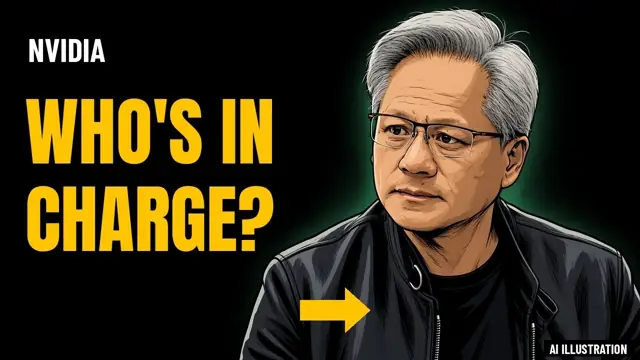 Watch ▶
Jensen Huang is gone, yet Nvidia just posted a record $115.8B quarter. In my view the key-person risk is real for the next platform after Vera Rubin, not for the next 4 quarters. Bear $325 · Bull $1,500.
Not financial advice.
Companies: Nvidia
Transcript
From the video captions, split by chapter. Timestamps link to that moment on YouTube. Corrections are marked inline.
5 passage(s) with price targets or valuation scenarios were removed from this transcript (see Methodology).
0:00 What does 2036 look like?
Twenty thirty-six. A dark keynote stage, one spotlight, an empty chair. Nvidia still powers the machines. The question is who sat in that chair, and what Nvidia became without the man who built it.
[Sentence removed on this site: price target or valuation scenario. See Methodology.] Here is the math, the future it builds, and what could break it.
0:25 What just happened?
On the eleventh of November, twenty twenty-six, Nvidia's board accepted Jensen Huang's resignation as president, chief executive and director, effective immediately. NPR and CNBC report it followed an internal investigation into his personal conduct. Chief financial officer Colette Kress, in that role since twenty thirteen, became interim CEO and stays CFO. Harvey Jones, a director since nineteen ninety-three and a former chief executive of Synopsys, became Nvidia's first-ever board chair.
Six days later, Huang said he would be honored to return. On the earnings call, Jones closed that door. The board, he said, unanimously accepted his resignation and does not intend to reinstate Jensen as CEO. Not everyone agreed.
A public petition to bring him back had nearly two hundred thousand signatures, and more than ten thousand signers say they work at Nvidia. That is self-reported, and Nvidia has roughly forty-two thousand people. Nvidia's value fell from about five point eight trillion dollars in early October to about three point nine trillion by the thirteenth of November, per Reuters and CNBC. Six straight weekly declines, the longest streak since twenty twelve.
Then the strangest part. Six days after the exit, Nvidia posted a record quarter and raised its outlook. The stock rose about five percent after hours, then closed down two point eight nine percent, about thirty percent below its October high. Founder discount, or broken company?
Hold that question.
2:02 What did Jensen actually build?
Thirty-three years ago, in nineteen ninety-three, Huang co-founded Nvidia at a Denny's with two friends and forty thousand dollars. He became its first and only chief executive. It started as a graphics chip company for PCs and gaming. The decisive move was software.
Nvidia built CUDA, an ecosystem for developers, and that ecosystem became the road into AI GPUs. In my view, that is the moat this whole story rests on. So can the machine run without the man who built it?
2:32 How does the machine make money?
The mechanism has four layers. First, the chips, the AI GPUs. Second, the networking that links them into one machine. Third, CUDA, the software developers already build on.
Fourth, full rack systems, where Nvidia ships the whole machine assembled. In my view, each layer makes the others harder to replace. That stack is why data center is almost the entire company. Data center revenue last quarter was one hundred seven point six billion dollars, up one hundred ten percent from a year earlier.
Hyperscale revenue alone was about sixty billion dollars, up twenty-three percent in three months. The newest layer is already out the door. Vera Rubin NVL72 is shipping, in what Nvidia calls the fastest product ramp in the company's history. Racks are running at CoreWeave, Google Cloud, Microsoft Azure, Oracle Cloud and Nebius.
3:29 How big did it just get?
Now the numbers. In the quarter to the twenty-fifth of October, revenue was one hundred fifteen point eight billion dollars. That is up one hundred three percent in a year and twenty percent in one quarter. Analysts expected about one hundred nine point one billion.
One quarter of Nvidia today brings in more than two of the same quarter a year ago. The third quarter of fiscal twenty twenty-six was fifty-seven billion dollars. The third quarter of fiscal twenty twenty-seven was more than double that. So why is the stock down?
Profit kept pace. GAAP gross margin was seventy-four point eight percent. Net income was sixty-five point three billion dollars in a single quarter. [Sentence removed on this site: price target or valuation scenario. See Methodology.]
Then the outlook. Nvidia guided the next quarter to about one hundred thirty billion dollars, against a consensus near one hundred twenty-five point one billion. Gross margin is guided to seventy-one to seventy-two percent, which the company describes as the low point. For fiscal twenty twenty-eight, the company raised its revenue growth outlook to about seventy-five percent, from seventy.
That is a plan, not a result. But it is a plan issued six days after the founder left. The biggest number came from Kress on the call. The cloud industry backlog is now two point five trillion dollars, up from two trillion three months earlier.
So what is all that capacity actually for?
5:01 What is all that capacity for?
Picture twenty thirty-six. This is our vision, not a fact. Endless halls of racks, descendants of Vera Rubin, running day and night. Today those racks run in five clouds.
In our vision, they become the power plants of the next economy. Second image. That two point five trillion dollar backlog stops being a line on an earnings call and becomes running capacity in every major cloud. In our vision, compute is metered like electricity, and Nvidia designs much of the grid.
Third image. A city at dusk where AI agents and machines do real work, routing, driving, building, while the racks behind them hum. Again, our vision, not a fact. But every piece of it starts with a chip, a network and CUDA code.
Here's the bet. In my view, the key-person risk is real, but not for the next four quarters. Those products are already shipping. It is real for the next big bet, the strategy after Vera Rubin.
The twenty thirty-six question is simple. Who picks the next platform?
6:06 What could break it?
Now the bear case, starting with an objection. A company this big doesn't need its founder. Maybe. But before he resigned, several analysts told CNBC his departure could cost Nvidia up to twenty percent of its market value.
[Sentence removed on this site: price target or valuation scenario. See Methodology.] Here is the fact most coverage missed. In its own annual report, Nvidia warns it is highly dependent on the services of its longstanding executive team. The Wall Street Journal also quoted Nvidia warning that failing to ensure effective succession planning could hinder its strategic planning, execution, and long-term success.
Read that next to how Huang ran things. About sixty direct reports. He said he didn't believe in classic succession planning. In October he said he was really hoping the next CEO was already at the company.
Now the board has hired the search firm Heidrick and Struggles. So far there are only reports. Arm's chief executive Rene Haas, sixty-four, who spent seven years at Nvidia running computing products, has reportedly been approached. Nothing is confirmed.
Would an outsider pick the same next platform Huang would have? The second risk, in my view, is customers. Hyperscale revenue is about sixty billion dollars a quarter, and those same clouds have every reason to design custom chips of their own. Kress told CNBC that customers are, in her words, all continuing to be with us.
The risk is that a leaderless year gives them room to drift. Third, margins. Gross margin was seventy-four point eight percent last quarter, and the guide for the next one is seventy-one to seventy-two. Nvidia calls that the low point, before seventy-two to seventy-three percent in fiscal twenty twenty-eight.
If the low point is not the low, every valuation shifts. So which is it? A founder discount on a machine that just printed its best quarter ever? Or the first crack in a company whose next platform has no author yet?
I'm leaving this one open on purpose. Pick a side.
8:13 What is it worth in 2036?
Not financial advice. The calculator starts from trailing twelve-month revenue of three hundred two point nine seven billion dollars, twenty-four point one billion shares, no dilution, and a price of one hundred sixty-two dollars eighty-five cents. Three cases for twenty thirty-six. Bear: ten percent revenue growth a year, a forty-five percent net margin, a price to earnings multiple of twenty-two.
[Sentence removed on this site: price target or valuation scenario. See Methodology.] Bull: twenty-two percent growth, a fifty-five percent margin, a multiple of thirty. About thirty-six point five trillion, or fifteen hundred dollars. The base case.
Fifteen percent growth a year, a fifty percent margin, a multiple of twenty-five, about fifteen point three trillion dollars. [Sentence removed on this site: price target or valuation scenario. See Methodology.] Pause and comment your own twenty thirty-six number for Nvidia. One honest caveat.
This preset does not price key-person risk at all. It assumes the next platform gets picked well. If you think the chair stays empty too long, your number sits closer to the bear case.
9:29 What should we watch next?
Three things to watch. First, who is named CEO, and when. An insider who knows the roadmap, or an outsider? In my view, every quarter that chair stays empty, the next platform gets decided by committee.
Second, gross margin. The company calls seventy-one to seventy-two percent the low point, and guides seventy-two to seventy-three percent in fiscal twenty twenty-eight. Back in that range, the machine is fine. Stuck below seventy-two, and something is breaking.
Third, fiscal twenty twenty-eight revenue growth against the outlook of about seventy-five percent. Clearly below it, and the founder discount starts to look earned. At or above it, and the market priced the wrong risk.
10:16 So who picks the next platform?
Back to that stage in twenty thirty-six, and that empty chair. Kress told staff this is a new era for Nvidia. In my view, the era will be defined by one decision: who sits in that chair when the platform after Vera Rubin is chosen. Bear, three hundred twenty-five dollars.
Base, six hundred thirty-five dollars. Bull, fifteen hundred dollars. Tell me which one happens, and why, in the comments. Is it worth a decade?
You decide. So, back to that empty chair. What's your twenty thirty-six number for Nvidia?
Sources (17)
| Fact | Source A | Source B |
|---|---|---|
| Huang co-founded Nvidia 33 years ago; first and only CEO until Nov 2026 | WSJ 12 Nov (archive.ph/TfBMo) | CNBC live 12 Nov |
| Kress interim CEO, CFO since 2013; Jones first-ever chair, on board since 1993, ex-CEO Synopsys | 8-K | Nvidia newsroom |
| Board "unanimously accepted his resignation and does not intend to reinstate Jensen as CEO" (Jones, earnings call 17 Nov) | NBC News https://www.nbcnews.com/business/corporations/nvidia-post-jensen-huang-kress-earnings-rcna609782 | CNBC 18 Nov https://www.cnbc.com/2026/11/18/nvidia-stock-earnings.html |
| Huang said 17 Nov he'd be "honored" to return | NBC News | CNBC 18 Nov https://www.cnbc.com/2026/11/18/nvidia-kress-jensen-huang-return.html |
| Petition to bring Huang back ~200,000 signatures, 10,000+ claiming to be employees; Nvidia ~42,000 employees | CNBC 18 Nov (kress-return) | (single outlet → say "according to CNBC", treat as reported) |
| Heidrick & Struggles hired to run CEO search (Jeff Sanders) | WSJ via Investing.com https://www.investing.com/news/stock-market-news/nvidia-taps-heidrick--struggles-to-lead-ceo-search-wsj-reports-5033757 | Guardian 19 Nov (citing Bloomberg) https://www.theguardian.com/technology/2026/nov/19/nvidia-new-ceo-search-jensen-huang-arm-rene-haas |
| Arm CEO Rene Haas approached; ex-Nvidia GM of computing products (7 yrs); other names reported: Ian Buck (Nvidia VP), Lisa Su (AMD), Johny Srouji (Apple) | Guardian/Bloomberg 19 Nov | WSJ via Investing.com |
| Q3 FY27 (to 25 Oct 2026) revenue $115.8B, +103% y/y, +20% q/q | Nvidia IR PR 17 Nov https://investor.nvidia.com/news/press-release-details/2026/NVIDIA-Announces-Financial-Results-for-Third-Quarter-Fiscal-2027/default.aspx | CNBC 17 Nov https://www.cnbc.com/2026/11/17/nvidia-nvda-earnings-report-q3-2027.html |
| Data Center revenue $107.6B, +110% y/y | Nvidia PR | CNBC 17 Nov / Investopedia |
| GAAP gross margin 74.8%; net income $65.3B; adj. EPS $2.68 vs $2.48 expected | Nvidia PR | CNBC 17 Nov / Yahoo Finance |
| Q4 FY27 guide $130B ±3% (vs ~$125.1B consensus), no China data-center compute assumed | Nvidia PR | CNBC 17 Nov |
| FY2028 revenue growth outlook raised to ~75% from 70% | Benzinga call transcript https://www.benzinga.com/content/63374236/nvidia-q3-2027-earnings-call-transcript | Investing.com transcript https://www.investing.com/news/transcripts/earnings-call-transcript-nvidia-tops-q3-2026-estimates-and-lifts-outlook-93CH-5034300 |
| Cloud industry backlog $2.5T, up from $2T three months ago (Kress, call) | Benzinga transcript | Investing.com transcript |
| Vera Rubin NVL72 shipping, "fastest product ramp in company history"; racks at CoreWeave, Google Cloud, Microsoft Azure, Oracle, Nebius | Nvidia PR | Benzinga transcript ("Vera Rubin ramp") |
| Market value fell from ~$5.8T (early Oct) to ~$3.9T (13 Nov); closed below $4T first time since Jul 2025; 6 straight weekly declines, longest since 2012 | Reuters via Investing.com https://www.investing.com/news/stock-market-news/nvidia-shares-set-for-335-billion-swing-after-earnings-options-show-5032318 | CNBC 13 Nov https://www.cnbc.com/2026/11/13/nvidia-nvda-stock-jensen-huang-transition.html |
| Stock popped ~5% after hours on results, then closed −2.89% at $150.96 on 18 Nov | NBC News / Yahoo Finance https://finance.yahoo.com/markets/stocks/article/nvidia-stock-erases-earnings-pop-as-investors-face-life-after-jensen-huang-173547783.html | CNBC 18 Nov |
| Huang owns ~3.6% of Nvidia, largest shareholder; ~60 direct reports; said he doesn't believe in classic succession planning | WSJ 11 Nov (archive.ph/ZmOEH) | NPR (Huang Oct Bloomberg quote on succession "next CEO already at the company") |
Facts in the video are checked against two independent sources. Market data is dated where it appears. Analyst price targets and the author's valuation scenarios are not reproduced on this site.