Home / Episodes / Chips & Fabs
· CHIPS & FABS · 10:57
Terafab: Why Musk Needs His Own Chip Factory
 Watch ▶
Terafab is Elon Musk's bet that chip supply, not chip design, becomes the bottleneck of the AI decade. Tesla, SpaceX and Intel plan to build a chip fab in Texas: a ~$3B research fab in Austin, then a main campus at Gibbons Creek with filings that add up to about $119B by the mid-2030s. In this video: what Terafab is, how a fab and EUV lithography actually work, the plan and the numbers, TSMC/Samsung/Intel, and an honest bull and bear case. This is analysis, not financial advice.
Not investment advice. Educational content and opinion only. The author may hold shares in companies discussed. Disclosure
Transcript
From the video captions, split by chapter. Timestamps link to that moment on YouTube. Corrections are marked inline.
0:00 Hook
Every AI model, every self-driving car and every humanoid robot runs on the same scarce thing: leading-edge chips. And one company, TSMC, now takes about seventy-two percent of the world's contract chipmaking revenue. So Elon Musk's companies decided to build their own chip factory. It's called Terafab, and its long-term goal is a terawatt of AI compute every year.
In March, Musk summed up the logic in one line: "We either build the Terafab or we don't have the chips, and we need the chips, so we build the Terafab." This is Bet The Decade: what Terafab is, why chips are so hard to make, the numbers, and an honest bull and bear case. This is analysis, not financial advice.
0:49 What Terafab is
Terafab was announced on March twenty-first, twenty twenty-six, in Austin, Texas. It is a joint project of Tesla and SpaceX, which now owns xAI. In April, Intel joined as a partner. It is meant to make two kinds of chips.
One is built for edge inference: the brain inside Tesla's cars and Optimus robots. The other is a high-power chip designed for AI satellites in orbit. The unusual part is the scope. The plan puts chip design, photomasks, logic, memory, advanced packaging and testing in one place, so engineers can change a design and see the result fast.
Why bother? Musk says his suppliers, like TSMC, Samsung and Micron, are only comfortable expanding at a certain rate, and that rate is far below what his companies want. SpaceX says the combined chip demand of SpaceX and Tesla is expected to exceed one terawatt of compute, which it calls significantly larger than today's global supply. For scale: on SpaceX's October earnings call, Musk said his AI business expects roughly three gigawatts of compute online by the end of this year, and about ten more gigawatts in twenty twenty-seven.
A terawatt is a thousand gigawatts.
2:11 How a fab works, and why it's hard
A chip starts life on a polished disc of silicon called a wafer. Many chips are built on each wafer at once, layer by layer. Each layer goes through a loop: deposit a thin film, coat it, print a pattern with light, etch it, clean it, and inspect it. Repeat that for dozens of layers, and an advanced wafer can go through more than a thousand process steps.
That takes time. A wafer typically spends around three months inside the fab, longer on the most advanced processes, before packaging and testing even begin. The hardest step is printing the finest layers. That takes extreme ultraviolet lithography, or EUV.
A powerful laser hits tiny droplets of molten tin, creating light with a wavelength of just thirteen and a half nanometers. Because EUV light is absorbed by almost everything, even air, the whole path runs in a vacuum. Mirrors instead of lenses guide the light onto a patterned mask, and from there down onto the wafer. Only one company in the world makes these machines: ASML, in the Netherlands.
The most advanced versions cost hundreds of millions of dollars each. Then there's yield: the share of chips on each wafer that actually work. A single tiny defect can kill a chip, and big AI chips have more area to catch one. So the same wafer can give you mostly good small chips, but far fewer good big ones.
New processes start with lower yields, and pushing them up takes months of tuning. Even Intel, with decades of experience, talks about yield improvement quarter by quarter. And the building itself is a machine. A fab runs around the clock, inside an ultra-clean room, and it needs huge, steady supplies of electricity and water.
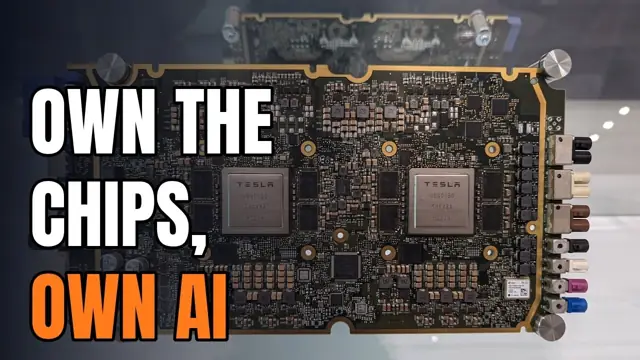
That's why the leading edge is such a small club. Tesla already designs its own AI chips, like the ones on this self-driving computer, but outside foundries such as TSMC and Samsung manufacture them.
4:19 The plan and the numbers
Step one is a research fab at Tesla's Giga Texas site in Austin: roughly a three billion dollar facility built for a few thousand wafers a month. It will use Intel's 14A manufacturing process. That makes Terafab a major early customer for 14A, which Intel plans to bring to high-volume manufacturing in twenty twenty-eight. Intel's CEO Lip-Bu Tan, on Intel's April earnings call: "As we look to continue challenging the status quo, I can think of no better partner than Elon Musk." The main campus goes in Grimes County, east of College Station, Texas, at Gibbons Creek, where a power plant once stood.
Process water is planned to come from the Gibbons Creek Reservoir. And SpaceX says it will bring its own power: natural gas plants and very large battery arrays, instead of relying on the grid. The first phase is budgeted at about sixteen point eight billion dollars. State tax filings sketch four phases running into the mid twenty-thirties, adding up to about one hundred nineteen billion dollars.
Musk's stated output targets are one hundred thousand wafer starts a month at first, and an ambition of one million a month at full scale. And the clock. On SpaceX's earnings call on October twentieth, Musk said the first test chip, a simple SRAM memory chip, is aimed at around May or June of twenty twenty-seven, at the Austin research fab. Then he said: "Our aspiration is to reach volume production around Q3 of 2028 at Terafab at Gibbons Creek, the main Terafab location." He thanked ASML and other suppliers for accelerating equipment deliveries, and added: "These are obviously insanely fast time frames for chip production."
6:12 The competition
So who is Terafab up against? According to TrendForce, TSMC took a record seventy-two and a half percent of global foundry revenue in the second quarter of twenty twenty-six. Samsung was second, with under six percent. TSMC plans to spend sixty to sixty-four billion dollars on capital expenditure this year alone.
And it has committed at least one hundred sixty-five billion dollars to its fabs in Arizona. Put that next to Terafab's first phase: about sixteen point eight billion dollars, spread over roughly three years. Terafab is big for a newcomer, but TSMC spends several times that every single year. Samsung is a Tesla supplier, too.
In July twenty twenty-five, Tesla signed a sixteen and a half billion dollar deal for Samsung to make its AI6 chips at its plant in Taylor, Texas. And Intel is both partner and rival. Its foundry business lost two point four billion dollars in the first quarter of twenty twenty-six, as it races to win outside customers for 14A. Terafab helps Intel make that case.
So Terafab does not replace these companies any time soon. SpaceX's own prospectus says it expects to keep sourcing a significant portion of its compute hardware from third-party suppliers.
7:38 The bull case
Here's the bull case to twenty thirty and beyond. One: demand. If AI compute keeps growing toward Musk's targets, owning chip supply could matter more than any single chip design. Two: speed.
With design, masks, chips and packaging in one place, each design loop could get much shorter. Three: partners. Intel brings a manufacturing process, and ASML is accelerating deliveries. Four: room to grow.
Four phases through the mid twenty-thirties mean Terafab can scale step by step, if the early phases work. In the bull scenario, the Austin fab proves the process in twenty twenty-seven, Gibbons Creek ramps around the end of the decade, and by twenty thirty-five Terafab is a major source of chips for robots, cars and orbital data centers. That's a scenario, not a forecast.
8:33 The bear case
Now the honest bear case, with data. First, the timeline. Research firm SemiAnalysis estimates Phase One needs about twenty months to build, seventeen months to equip, and six months to ramp. That points to volume production around mid twenty thirty, nearly two years after Musk's aspiration.
Musk himself put it plainly on the call: "we don't know if we will actually achieve this or not". Second, the deal itself. SpaceX's prospectus says Terafab is in "the very early stages", that "neither Tesla nor Intel are obligated to remain a part of the project", and that there's no assurance of hitting its objectives "within the expected timeframes, or at all". Third, experience.
Tesla and SpaceX have never run a leading-edge chip fab, and Bloomberg has pointed to Musk's history of over-promising on goals and timelines. Fourth, scale. A terawatt a year is far beyond today's entire AI infrastructure. Local reporting described it as more than ten times all current AI capacity.
Fifth, local friction. Grimes County approved a one hundred percent tax abatement in a four-to-one vote, over strong objections from residents. And in September, SpaceX sued to block the release of project records. And the power plan leans on natural gas turbines, which brings its own cost and emissions questions.
10:01 The thesis
So here is the thesis. Terafab is a bet that, in the AI decade, chip supply, not chip design, becomes the real bottleneck, and that whoever controls supply controls the pace. The vision is huge, and the partners are real. The timeline is aggressive, and the risks are written into SpaceX's own filings.
Both can be true at the same time. Here's what to watch: the first test chip from Austin around mid twenty twenty-seven; Intel 14A reaching volume in twenty twenty-eight; EUV tools arriving on site; construction progress at Gibbons Creek; and whether Tesla and Intel sign definitive agreements. Is Terafab the boldest industrial bet of the decade, or a step too far? Tell me in the comments.
This is Bet The Decade. Not financial advice.
Sources (39)
| Beat | Fact (as narrated) | Source 1 | Source 2 |
|---|---|---|---|
| k_title | Terafab long-term goal: 1 TW of compute per year | SpaceX 424B4 (05.2026) "one terawatt of compute hardware each year" https://www.sec.gov/Archives/edgar/data/1181412/000162828026042639/spaceexplorationtechnologi.htm | Boston Globe/Bloomberg 22.03.2026; Reuters via Investing 20.10.2026 |
| q_build | Quote VERBATIM "We either build the Terafab or we don't have the chips, and we need the chips, so we build the Terafab." Musk, 21.03.2026 Austin event | The Verge 22.03.2026 (quoting Bloomberg) https://www.theverge.com/ai-artificial-intelligence/898722/musk-terafab-chip-plant | Boston Globe 22.03.2026 https://www.bostonglobe.com/2026/03/22/nation/musk-tesla-spacex-xai-chip-project-to-kick-off-in-texas/ |
| d_launch | Announced 21.03.2026, Austin (Seaholm); Tesla + SpaceX; SpaceX owns xAI (Feb 2026); Intel joined April 2026 (07.04) | Electrek 22.03.2026; BI 22.03.2026 | Reuters 07.04.2026; S-1 ("Intel joined the project in April 2026") |
| d_twochips | Two chip types: edge/inference (cars, Optimus) + high-power chip for space/AI satellites | Boston Globe 22.03.2026 | Bits&Chips 24.03.2026; Electrek 22.03.2026 |
| d_loop | Design, photomasks, logic, memory, packaging, test in one place | Electrek 22.03.2026 ("every stage ... under one roof") | GCCRD JETI summary (design, photomask generation, wafer fabrication, advanced packaging); Bits&Chips |
| d_why | Suppliers (Samsung, TSMC, Micron) expand at a max rate far below what Musk wants (paraphrase) | Boston Globe 22.03.2026 | Bits&Chips 24.03.2026; Electrek 22.03.2026 |
| k_demand | SpaceX+Tesla demand expected >1 TW, "significantly larger than the current global supply" | SpaceX update 06.08.2026 https://www.spacex.com/updates/index | Tesla X post 06.08.2026 ("far more chips than current & future global production can supply"); TheElec (global ~20 GW/yr vs 1 TW) |
| c_gw | ~2.5–3 GW by end-2026, +~10 GW in 2027 | SpaceX Q3 call transcript 20.10.2026 (research/spacex-q3-2026-call.txt) | Tom's Hardware 21.10.2026 |
| d_steps | Layer loop; advanced wafer >1,000 process steps | SIA 26.02.2021 ("up to 1,400 process steps") | SemiEngineering "Battling Fab Cycle Times" ("600 to 1,000 steps or more") |
| d_cycle | ~3 months in fab, longer for advanced, before packaging/test | SIA 2021 (12 weeks avg, 14–20 advanced; ATP +6 weeks) | Wikipedia Semiconductor device fabrication / Chip Field Guide (11–13 weeks avg, up to 15) |
| d_euv | EUV: laser hits molten tin droplets → 13.5 nm light | ASML EUV systems page | CNBC 29.01.2026 (tin droplets); Wikipedia EUV / Chip Field Guide (13.5 nm) |
| d_euv2 | Absorbed even by air → vacuum; mirrors not lenses; mask → wafer | ASML EUV systems page | CNBC 29.01.2026 |
| k_asml | ASML only maker of EUV; advanced tools cost hundreds of millions | CNBC 29.01.2026 (only EUV maker; €320–400M high-NA, ~€220M low-NA) | Tom's Hardware 21.10.2026 / Reuters 2024 (High-NA ~$350M) |
| d_yield | Defect kills die; larger die → lower yield | Wikipedia Semiconductor device fabrication (TSMC 5nm: ~80% small die vs 32% at 100 mm²) | Chip Field Guide "Why big chips yield worse" |
| d_ramp | New processes start low yield; months of tuning; Intel reports yield gains quarter by quarter | SIA 2021 (~24 weeks to ramp yields) | Intel Q1 2026 call (Motley Fool transcript 23.04.2026); TheElec |
| d_fabxs | Fab runs 24/7, cleanroom, large water & power use | Wikipedia Semiconductor device fabrication (24/7, clean room, large amounts of water) | ENR 08.10.2026 / TechCrunch 06.08.2026 (Terafab: onsite power plants, reservoir water) |
| ph_fsd | Tesla designs own AI chips; TSMC/Samsung manufacture them | Boston Globe 22.03.2026 (TSMC, Micron suppliers; Samsung agreement) | Reuters 28.07.2025 (Samsung AI6); Electrek 22.03.2026 |
| ph_gigatx | Research fab at Giga Texas, ~$3B, few thousand wafers/month | Bloomberg 22.04.2026 | Tesla Q1 2026 call transcript (semiconalpha) |
| d_intel | Terafab to use Intel 14A (announced 22.04.2026); 14A HVM 2028 | Reuters 22.04.2026; Nikkei Asia | TechPowerUp / Tom's / TrendForce 07.2026 (14A HVM 2028, risk 2H27) |
| q_tan | Quote VERBATIM "As we look to continue challenging the status quo, I can think of no better partner than Elon Musk." Lip-Bu Tan, CEO Intel, Q1 call 23.04.2026 | Motley Fool transcript 23.04.2026 | Tom's Hardware 23.04.2026 (headline + body) |
| map_tx | Grimes County, east of College Station, Gibbons Creek, former power plant site | KBTX 03.06.2026 ("where the Gibbons Creek Power Plant once stood") | TechCrunch 06.08.2026; ENR 08.10.2026 |
| ph_gibbons | Water from Gibbons Creek Reservoir; own natural gas plants + very large battery arrays | TechCrunch 07.08.2026 (Bloomberg) | ENR 08.10.2026; TechCrunch 06.08.2026 |
| c_phases | Phase 1 ≈$16.8B; four phases to mid-2030s; up to ≈$119B | ENR 08.10.2026 (P1 2026–28 $16.8B; P2 2029–31 $38.6B; P3 2032–34 $38.6B; P4 2035–36 $25.3B) | GCCRD JETI summary ($119.39B, four phases); KBTX 03.06.2026 ($119B); TechCrunch 07.08.2026 ($16.8B) |
| c_wafers | 100k wafer starts/month initially; ambition 1M/month | Electrek 22.03.2026 | Bits&Chips 24.03.2026 |
| d_timeline | First test chip (SRAM) ~May/June 2027 at Austin research fab | SpaceX Q3 call transcript 20.10.2026 | Tom's 21.10.2026 (Q2 2027); Reuters/Investing 20.10.2026 |
| q_q3 | Quote VERBATIM "Our aspiration is to reach volume production around Q3 of 2028 at Terafab at Gibbons Creek, the main Terafab location." Musk, CEO SpaceX, 20.10.2026 | Transcript | Reuters via Investing 20.10.2026 |
| q_insane | Quote VERBATIM "These are obviously insanely fast time frames for chip production." + thanks ASML for accelerating deliveries | Transcript | Tom's 21.10.2026; Reuters/Investing (Reuters wording adds "like" — we use transcript wording, cite transcript) |
| ph_tsmc | TSMC 2026 capex $60–64B; ≥$165B Arizona commitment | Focus Taiwan 15.10.2026 | TSMC 3Q26 call; TSMC PR 03.2025 + NYT 03.03.2025 ($165B) |
| d_samsung | Tesla–Samsung $16.5B AI6 deal, Taylor TX, July 2025 | Reuters 28.07.2025 | Bloomberg 28.07.2025 / TheElec |
| ph_intel | Intel Foundry Q1 2026 operating loss $2.4B | Intel Q1 call (Motley Fool transcript) | Tom's Hardware 23.04.2026 (-45% operating margin) |
| k_frenemies | SpaceX expects to keep sourcing significant portion of compute hardware from third parties | SpaceX 424B4 | Electrek 20.05.2026 (same risk section) |
| d_semian | SemiAnalysis: 20 mo build + 17 equip + 6 ramp → volume ~mid-2030 | Tom's Hardware 14.10.2026 | teslanewswire (SemiAnalysis) 10.2026 |
| q_dontknow | Quote VERBATIM "we don't know if we will actually achieve this or not" Musk 20.10.2026 | Transcript | Reuters via Investing 20.10.2026 |
| doc_s1 | S-1 VERBATIM: "very early stages"; "neither Tesla nor Intel are obligated to remain a part of the project"; "within the expected timeframes, or at all" | SpaceX 424B4 (research/s1.txt, verified) | Electrek 20.05.2026 (quotes all three) |
| k_exp | No leading-edge fab experience; Bloomberg on history of over-promising | Boston Globe/Bloomberg 22.03.2026; The Verge 22.03.2026 | Electrek 22.03.2026 ("zero semiconductor manufacturing experience"); transcript ("we're just figuring out chip fabrication") |
| k_scale | 1 TW >10× current AI capacity | KBTX 03.06.2026 | Tom's (Gartner ~44 GW AI DC capacity) / TheElec (~20 GW/yr global semi output vs 1 TW) |
| d_local | 100% abatement, 4–1 vote, resident objections; SpaceX sued 08.09.2026 to block records | KBTX 03.06.2026; TechCrunch 07.08.2026 | KBTX 10.09.2026; USA Today 10.09.2026; ENR 08.10.2026 |
| d_gas | Natural gas power; emissions concerns | TechCrunch 07.08.2026 | Bloomberg 06.08.2026; ENR |
| list_watch | 14A volume 2028; first test chip mid-2027; definitive agreements pending | (see above) | (see above) |
Facts in the video are checked against two independent sources. Market data is dated where it appears. Analyst price targets and the author's valuation scenarios are not reproduced on this site.