· AI POWER · 12:59
How TeraWulf Turns Power Into AI Rent in 2026
 Watch ▶
My TeraWulf thesis: power becomes a rent-producing AI infrastructure platform — if construction and financing preserve the economics.
Q3 2026 changes the revenue mix: approximately $63M of HPC lease revenue inside $76.2M total revenue. This developed episode follows the chain from secured power to contracted customers, project financing, delivered capacity and rent.
We separate 102 MW online from 336 MW under construction at Lake Mariner, explain the Anthropic/Justified commitment and Muskie approval condition, and distinguish tenant revenue from warrant remeasurement and asset-sale gains.
Not financial advice.
Companies: TeraWulf
Transcript
From the video captions, split by chapter. Timestamps link to that moment on YouTube. Corrections are marked inline.
1 passage(s) with price targets or valuation scenarios were removed from this transcript (see Methodology).
0:00 What is the TeraWulf bet after Q3 2026?
My bottom line: TeraWulf is becoming an AI infrastructure landlord, because the bet is power turning into rent, not a paper profit. Eighty-three percent of third-quarter revenue now comes from high-performance computing leases. That is the hinge of this story. The usual explanation is another bitcoin miner riding the AI trade.
I think that misses the mechanism. Secured electricity supports a campus. A signed lease supports financing. Finished capacity starts collecting rent.
Each arrow can fail. But when those arrows connect, this is a different business. This is Bet The Decade. Not financial advice.
The company reported sixty-three million dollars of computing lease revenue inside seventy-six point two million dollars of total sales. Now let us separate the operating transformation from the spectacular accounting headline.
0:55 How does power become an AI lease?
Start with first principles. An AI model cannot run on a press release. It needs energized computing capacity, not just land on a map. TeraWulf says one hundred and two megawatts of critical IT capacity were generating revenue at Lake Mariner at quarter end.
That is our starting line. Critical IT power is power for computing equipment. Utility power also has to support the rest of the facility. Keep that distinction in your head, because a huge utility agreement is not automatically a huge operating data center.
I refuse to value an unfinished campus as if every rack were already paying rent. The next link is three hundred and thirty-six megawatts under construction at Lake Mariner. This is where my conviction lives, and where it gets tested. Construction spending comes before rent.
A signed customer does not remove that gap. It gives you a reason to try to bridge it. Put the numbers side by side. One hundred and two operating.
Three hundred and thirty-six being built. I see an execution pipeline, not a reason to pretend the whole pipeline is finished. The bull case is delivery converting potential into cash receipts. The bear case is time and money leaking between those stages.
The release points to phased delivery and rent commencement for CB-four in the fourth quarter, with CB-five starting phased delivery in early twenty twenty-seven. Those are management expectations, not facts from the future. I want completion evidence and rent, not a prettier construction photograph.
2:32 What do the Q3 numbers actually prove?
Here is why seventy-six point two million dollars matters to me. The total is still a quarterly revenue figure. It is not proof that the expansion has earned an attractive return. But the mix tells us which engine is starting to pull the business.
Computing leases are now the dominant source of sales. About eighty-three percent from computing leases is evidence that the pivot is more than a slogan. It does not prove that every new project will earn its cost of capital. What it does is move the argument.
The key question becomes delivery economics, rather than whether the company has any meaningful leasing revenue at all. Now the uncomfortable number: adjusted earnings before interest, taxes, depreciation and amortization were negative twelve point eight million dollars. This is the company's non-GAAP measure, not free cash flow. I can be enthusiastic about the revenue mix and still insist the operating economics have work left to do.
Then comes the number that can completely derail the conversation. Net income attributable to TeraWulf was about seven hundred and nine point nine million dollars. If you take that as recurring earning power, you are analyzing the wrong quarter. The underlying statements tell a much more complicated story.
A roughly seven hundred and twenty-eight point four million dollar non-cash gain from changes in warrant and derivative liability values helped drive that reported profit. That is not cash paid by a tenant. It is an accounting remeasurement. No fraud story is needed.
Just read the bridge before celebrating the bottom line. Operating loss was about eighty-eight point two million dollars. That sits alongside the positive net income, because they measure different levels of the income statement. The leasing ramp can be real while the headline profit is a poor guide to recurring performance.
Both statements can be true. That is the point. There was also a roughly ninety-five million dollar gain on the Abernathy stake sale. Again, a sale can help allocate capital without becoming recurring rent.
My discipline is simple: separate tenant revenue, project spending, asset monetization and valuation changes. Otherwise one big bottom-line number swallows the actual investment thesis.
4:50 How big is the Anthropic opportunity?
Now zoom out to the opportunity I actually care about. The Anthropic lease at Justified covers about four hundred and one megawatts of critical IT capacity. This connects a named customer to a named development. It is a substantial commitment.
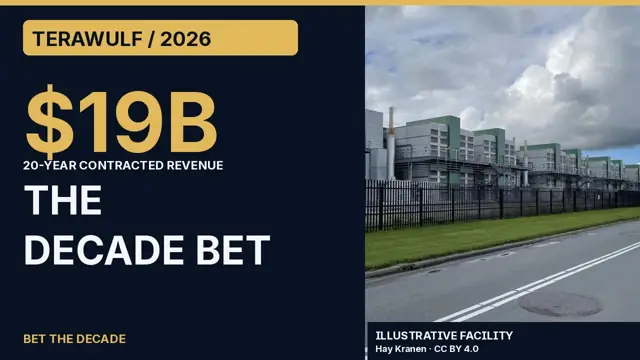
It is not yet a substantial operating campus collecting its full rent. The headline is approximately nineteen billion dollars of contracted revenue over a twenty-year initial term. Read every word. Contracted revenue, over time.
Not nineteen billion in the bank. Not nineteen billion of profit. The scale is exciting precisely because the job of delivering it is so demanding. The company announced a Google credit backstop supporting anticipated project financing, plus a definitive engineering, procurement and construction agreement with Fluor.
My causal chain is credit support, then financeability, then construction, then rent. A backstop helps a link in that chain. It does not guarantee every link or make this equity risk-free. Management expects phased service at Justified to start in late twenty twenty-seven and continue through the second quarter of twenty twenty-eight.
So the investment is partly a bet on a future delivery calendar. I want you to feel the ambition, but also the time distance between a signed contract and a rent-producing asset. For me, the nineteen-billion-dollar contract is a starting gun, not a finish line. The exciting part is the possibility of turning a power position into long-duration customer relationships.
The hard part is preserving the economics while doing it. A bigger project can create more value, or simply create a bigger funding problem.
6:34 What does a gigawatt at Muskie really mean?
Muskie expands the option set. Contracted utility power increases from five hundred megawatts to one thousand megawatts, subject to approval by the Kentucky Public Service Commission. That condition is part of the claim, not a footnote to hide. And these are utility megawatts, not a declaration of operating critical IT capacity.
One gigawatt of contracted power can be strategically valuable. But a power agreement does not install cooling, commission a building, sign a tenant or pay a shareholder. The opportunity is control over an input. The investment result depends on converting that input into delivered service with sensible financing.
TeraWulf reaffirms a target of contracting two hundred and fifty to five hundred megawatts of additional critical IT capacity each year. I read that as a statement of ambition and sourcing discipline. Contracting is not delivery. Repeating the target is not proof that capital and construction will arrive on schedule.
7:36 To be fair: what could break this thesis?
To be fair, the balance sheet gives the company room to move. Quarter-end cash, cash equivalents and restricted cash totaled about two point four billion dollars. But restricted cash is not a free spending account. I will not divide the biggest liquidity headline by a convenient expense figure and call the whole build funded.
The Abernathy sale delivered two hundred and fifty million dollars of cash during the quarter. That is different from the ninety-five million dollar accounting gain. Cash proceeds help liquidity. A gain helps the income statement.
Neither should be quietly relabeled as tenant operating performance. This distinction is basic, and it matters enormously. Here is the construction constraint. The company says WULF Compute remains within guidance of eight to ten million dollars per critical IT megawatt.
That is a lot of capital per unit of delivery. I do not export that guidance to every campus or assume it captures every corporate financing need. A delay can postpone rent while capital remains tied up. Less favorable financing can leave less value for equity.
And if delivery economics deteriorate, a growing megawatt count can coexist with disappointing shareholder returns. My conviction is in the mechanism working, not in the idea that AI demand forgives every mistake. I will change my mind if delivered capacity fails to translate into reliable rent, if construction discipline breaks, or if financing erodes the equity economics. The one-hundred-and-two-megawatt operating base is the anchor.
Future announcements have to earn their way into that operating category. A lower share price alone does not answer any of those questions.
9:23 The Math: how do I avoid counting the same value twice?
This chapter presents the author's personal valuation scenarios. They are not reproduced on this site because we do not publish price targets or valuation multiples. Watch the video for full context.
10:51 Why hold through the drawdown if the thesis is alive?
Here is my conviction. An eighty-three-percent computing lease revenue mix tells me the transformation has begun to show up in the business. Sitting through volatility only makes sense if delivery, customer commitments and funding economics keep the thesis alive. That is a conditional thesis, not blind loyalty to a ticker.
If price falls while the business evidence improves, I may see a gift. If the economics worsen, a cheaper quote can be a warning. The distinction is everything. I do not need a chart to tell me what I want to hear.
I need operating evidence that deserves the risk I am taking. Fast-forward a decade. I am not mechanically multiplying the annual contracting target by the years ahead. I am asking whether this team can repeat a difficult sequence: secure power, sign credible customers, fund construction and deliver rent.
If that sequence becomes repeatable, the platform can be more important than one quarter's noisy profit. My next checkpoints are concrete. Phased rent commencement at CB-four. Delivery progress at CB-five.
Financing and construction progress at Justified. Regulatory approval at Muskie. And, across all of them, the relationship between money spent and rent earned. If those improve, the thesis strengthens.
If they weaken, I do not move the goalposts. Come back to eighty-three percent. It is not the ending. It is evidence that a former mining-centered business is shifting toward computing leases.
My decade bet is that power becomes a rent-producing platform without destroying the economics on the way there. Not financial advice. You decide whether the evidence earns a decade. Watch our data-center accounting episode next if you want the deeper framework for separating operating progress from paper earnings.
That is how I intend to follow this bet: conviction with checkpoints, ambition with arithmetic, and no pretending that a contract is cash already collected.
Sources (23)
| Claim / exact scope | Source pair |
|---|---|
| Q3 2026, ended September 30, 2026; release November 6, 2026 | P + I/B |
| Q3 total revenue $76.230M, displayed/spoken ~$76.2M | P + I/B |
| Q3 HPC lease revenue $62.986M, displayed ~$63.0M; ~83% of total | P + I/E/B |
| Lake Mariner 102 MW revenue-generating critical IT capacity at Sep 30 | P + I/E/B |
| Lake Mariner additional 336 MW under construction; not operational | P + I/E/B |
| Critical IT vs utility power distinction; utility includes cooling/other facility systems | P operating labels + E explicit definitions |
| CB-4 phased delivery/rent commencement Q4 2026; CB-5 phased delivery early 2027; management targets | P + E/B |
| Adjusted EBITDA approximately −$12.8M, company non-GAAP, not cash flow | P reconciliation + E/B |
| Net income ATTRIBUTABLE to TeraWulf ~$709.9M; not $709.5M consolidated NI | P financial statements + B |
| Non-cash warrant/derivative liability fair-value gain $728.442M, rounded $728.4M | P financial statements + B |
| Q3 operating loss $88.225M, rounded $88.2M | P financial statements + B |
| Abernathy sale gain $94.995M, rounded $95M; nonrecurring sale gain, not tenant rent | P + E |
| Justified Anthropic lease: ~401 critical IT MW, 20 years, ~$19B contracted revenue initial term | P + I/E/B |
| Google credit backstop for anticipated project financing; definitive Fluor EPC agreement | P + I/E/B |
| Expected Justified phased ready-for-service late 2027 through Q2 2028, not completed delivery | P + E |
| Muskie contracted utility power 500→1,000 MW (=1 GW), subject to Kentucky PSC approval | P + I/E/B |
| Annual target contracting 250–500 MW incremental critical IT capacity, not annual delivery guidance | P + I/B |
| Quarter-end cash, equivalents AND restricted cash ~$2.4B, not all unrestricted | P + I/E/B |
| Abernathy sale cash received during quarter $250M; distinct from $95M sale gain | P + I/E |
| WULF Compute / Lake Mariner cost guidance $8–10M per critical IT MW; not automatically every campus | P + E |
| Derived Q3 operating margin = −88.225 / 76.230 ×100 = −115.7353%, displayed −115.7% | Inputs P + B; explicit calculation |
| Derived simple initial-term lease average $19B/20 = ~$950M/year; NOT annual recognition or guidance | Inputs P + I/E/B; explicit arithmetic |
| Derived scale check 336×$8–10M = $2.688–3.360B, displayed ~$2.7–3.4B; NOT remaining capex and NOT additional company guidance | Inputs P + E; scope caveat required |
Facts in the video are checked against two independent sources. Market data is dated where it appears. Analyst price targets and the author's valuation scenarios are not reproduced on this site.