Home / Episodes / Chips & Fabs
· CHIPS & FABS · 10:53
Colossus 2 Hit 1.1M Chips. Microsoft's AI Is Still $37B
 Watch ▶
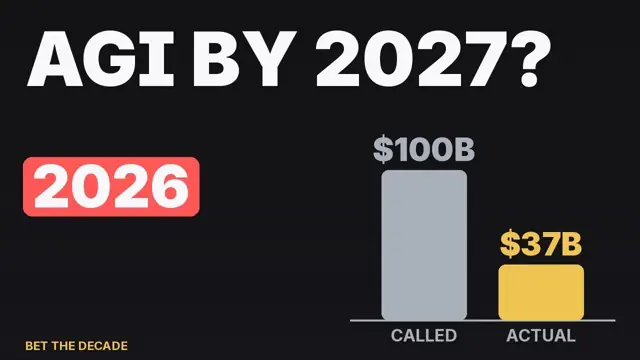
In June 2024, a former OpenAI researcher's essay, Situational Awareness, said the biggest AI cluster of around 2026 would hold about 1M top chips and draw about a gigawatt. This year Epoch AI estimates Colossus 2 at about 1.1M chip-equivalents and roughly 950 MW. The essay also pictured $100B a year of AI revenue for a big tech company by ~2026. Microsoft's last figure was a $37B run rate. The compute arrived. The revenue is late.
In this episode: what the essay claimed (AGI by 2027, an intelligence explosion, trillion-dollar clusters, lab security, superalignment, the US-China race, a government project), what came true, what has not, the most common objection, and what it means for the companies building the hardware: CoreWeave, Cerebras and SpaceX.
Not financial advice.
Companies: CoreWeave · Cerebras Systems · SpaceX
Transcript
From the video captions, split by chapter. Timestamps link to that moment on YouTube. Corrections are marked inline.
1 passage(s) with price targets or valuation scenarios were removed from this transcript (see Methodology).
0:00 An essay called 2026's AI clusters. Why is revenue behind?
In June twenty twenty-four, a former OpenAI researcher published an essay saying the biggest AI cluster of around twenty twenty-six would hold about a million top chips, draw about a gigawatt, and cost tens of billions of dollars. This year, the research group Epoch AI estimates the leader at about one point one million chip-equivalents and about thirty-six billion dollars. Here's the strange part. The same essay said a big tech company could be making a hundred billion dollars a year from AI by around twenty twenty-six.
The last number Microsoft gave, in April, was a thirty-seven billion dollar annual run rate. The machines arrived roughly on schedule. The money is behind. The usual answer: it was hype, and the spending is a bubble.
Some of that is fair. But what if the essay was early on the money, and right about the build? This is Bet The Decade. Today: what the essay claimed, what came true, what didn't, the biggest objection, and what it means for the companies building the hardware.
Not financial advice.
1:05 What did Situational Awareness actually predict?
The essay is called Situational Awareness: The Decade Ahead, by Leopold Aschenbrenner. Its method: count the factors of ten. In his words, it just requires believing in straight lines on a graph. He counted roughly three times more effective compute a year from bigger computers, and roughly three times from better algorithms.
From that, the essay made a chain of bets. Artificial general intelligence by twenty twenty-seven, which he called strikingly plausible. Then an intelligence explosion, with hundreds of millions of automated AI researchers compressing a decade of progress into a year or less. And a race to trillion-dollar clusters by the end of the decade.
Then the challenges. Labs would have to lock down their secrets against state hackers. Controlling systems smarter than us, called superalignment, was still unsolved. America and China would race.
And by twenty twenty-seven or twenty twenty-eight, he expected some form of government AGI project. One small call is worth a look first. In a footnote, he wrote that Nvidia would do over two hundred billion dollars of revenue in calendar twenty twenty-five. Nvidia's fiscal year that ended in January twenty twenty-six came in at two hundred fifteen point nine billion dollars.
2:26 How close did the compute call get?
Start with the clusters. The essay's table put the biggest training cluster of around twenty twenty-six at about a million top chips, about a gigawatt of power, roughly a large nuclear reactor, and tens of billions of dollars. Now this year. SpaceX's own filing calls its Colossus Two site in Memphis a gigawatt-scale AI training cluster.
Epoch AI estimates it at about one point one million chip-equivalents, about nine hundred fifty megawatts of computing power, and a cost of about thirty-six billion dollars. On this one, the straight line held. Then the money going in. The essay guessed about five hundred billion dollars of total AI investment a year by around twenty twenty-six.
In late October, Microsoft, Alphabet, Amazon and Meta together guided to seven hundred twenty to seven hundred forty billion dollars of capital spending for this year. Not all of it is AI, but AI is the main driver. And the essay's next marker, over a trillion dollars a year by twenty twenty-seven? Hyperscaler spending is expected to top a trillion dollars next year, according to estimates reported by CNBC and Reuters.
A forecast, not a fact yet. Power was the essay's biggest bottleneck. A report for the U.S. Energy Department counted all data centers at four point four percent of U.S. electricity in twenty twenty-three, and projected six point seven to twelve percent by twenty twenty-eight.
The essay's path was steeper: about five percent for AI alone by around twenty twenty-six.
4:01 Where did the forecast run ahead of reality?
Now the misses, or at least the delays. The essay's favorite milestone was a big tech company at a hundred billion dollars a year of AI revenue by mid twenty twenty-six. Microsoft said in April that its AI business passed a thirty-seven billion dollar run rate, up one hundred twenty-three percent in a year. Fast growth, but about a third of the milestone.
The essay also expected ten-trillion-dollar companies. Today, the world's most valuable company is worth roughly five trillion dollars. And AGI by twenty twenty-seven? In our view, not yet, by most definitions.
But the trend the essay leaned on is still running. The group METR measures how long a software task an AI agent can finish half the time. GPT-5 was at about two hours. By May twenty twenty-six, the best model it measured was at sixteen hours or more, where METR says its tests stop being reliable.
And METR warns this is not the same as automating a job.
5:04 What happened to security, alignment and China?
The essay's loudest warning was security. It said the leading labs treat security as an afterthought. In February twenty twenty-six, Anthropic said three Chinese AI companies used about twenty-four thousand fraudulent accounts to pull more than sixteen million exchanges out of its Claude models to train their own. Not a theft of the model itself, but the kind of leak the essay worried about.
On alignment, the team the author had worked with at OpenAI, Superalignment, was disbanded in May twenty twenty-four, weeks before the essay came out, after its two leaders left. In our view, the problem it named is still open. On China, the essay said China was not at all out of the game. Epoch AI estimates Chinese models have trailed the U.S. frontier by about seven months on average since twenty twenty-three.
Close behind, not out. And the government project? In November twenty twenty-five, the White House launched the Genesis Mission, led by the Energy Department, linking seventeen national labs into one AI platform for science. A real government AI project, but so far for science, not the secret AGI effort the essay described.
6:18 The objection: isn't this all a bubble?
Here's the most common objection, in one sentence: AI revenue is far too small to pay for all this spending, so it's a bubble. Here's a number that answers it, at least in part. Microsoft alone reports six hundred seventy-seven billion dollars of signed commercial contracts it hasn't delivered yet, up seventy-three percent in a year. That's not hope.
It's paperwork. In our view, the bigger risk is how concentrated those contracts are, not a lack of demand. And CoreWeave, one of the companies renting out these clusters, ended September with about one hundred thirty-two point five billion dollars of backlog, against three point six six billion of revenue in the quarter.
7:02 What does it mean for the companies building it?
Here is how exponential AI shows up in these businesses, in our view. If the compute line keeps rising faster than revenue, the first to get paid are the builders: power, chips and rented clusters. Their customers carry most of the revenue bet. The builders' contracts get signed first.
Now the portfolio. SpaceX, which now owns the Colossus sites, reported about one point seven gigawatts of compute at the end of September, up from zero point six a year earlier. Cerebras, the wafer-scale chipmaker, reported twenty-six point one billion dollars of signed backlog against two hundred thirty-one million dollars of core revenue last quarter, up seventy percent. A large part of that backlog is tied to OpenAI, according to the company.
So the essay's map, in our reading, puts the earliest money in the build layer: clusters like CoreWeave, chips like Cerebras, and compute plus launch like SpaceX. The revenue risk sits mostly with their customers, the AI labs, which is why these stocks swing when the labs change plans. Now a vision, not a fact. Picture twenty thirty-six.
If the essay's line keeps going even at half its speed, AI compute is measured in hundreds of gigawatts, some of it in orbit,. That's a scenario, not a promise.
8:23 To be fair: what if the essay is wrong?
To be fair, the essay itself says the error bars are large. It names the risk of running out of training data, which could stall progress. A longer benchmark task is not a worker. And spending can run ahead of revenue for years.
The essay itself notes that telecom companies put nearly a trillion of today's dollars into internet infrastructure between nineteen ninety-six and two thousand one. Much of that fiber sat unused, and the industry crashed before the traffic arrived. One more fact. Its author started an investment fund built on these ideas.
In July twenty twenty-six, after AI infrastructure stocks fell sharply, the fund sold most of its public stock holdings to Citadel, according to Reuters and Bloomberg. The direction he described is still playing out. The path was brutal.
9:15 Run the Numbers: CoreWeave on our calculator
So run the numbers yourself. Our calculator on the CoreWeave page at bet the decade dot com lets you change three inputs for CoreWeave: revenue, net margin and the earnings multiple. [Sentence removed on this site: price target or valuation scenario. See Methodology.] Change one input and see how much of the essay's world you are assuming.
Scenarios, not price targets. Not financial advice.
9:46 What is the lesson for a long-term investor?
The lesson I take: separate the build from the bills. The essay's compute line was close. Its revenue line is late. Being early is not the same as being wrong, but only if you can survive the path.
So here's what I watch next. Does Colossus Two reach about one and a half gigawatts of computing power by early twenty twenty-seven, as Epoch AI projects? When does Microsoft give its next AI revenue number? Does spending next year top a trillion dollars?
And does the Genesis Mission stay a science program? Back to one point one million chips and thirty-seven billion dollars. The bet: if the revenue line catches up with the compute line, the companies building it were early, not wrong. If it doesn't, the build slows and the weakest balance sheets break first.
Not financial advice. Is it worth a decade? You decide. The full breakdown is on bet the decade dot com.
And to see how one of these builders actually makes money, watch our CoreWeave episode next.
Sources (20)
Facts in the video are checked against two independent sources. Market data is dated where it appears. Analyst price targets and the author's valuation scenarios are not reproduced on this site.